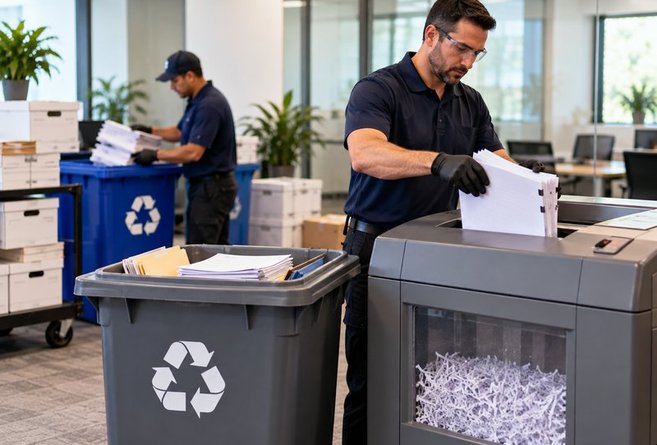
If your office handles client files, payroll records, or anything with personal information on it, yes. Paper recycling takes care of everyday waste paper, but confidential records need secure destruction, and the smart move is to handle both with one vendor and one pickup schedule. To set up a combined plan for your office, contact our team or call (609) 393-6445.
Paper recycling is for paper that carries no sensitive information. Secure destruction is for anything that does, and it ends with the paper made unreadable before it is recycled.
Think of it as two streams. The first is the everyday stuff: printer misfires, junk mail, old flyers, packaging inserts, and drafts with nothing private on them. That paper goes to waste paper recycling, and in New Jersey recycling it is not optional anyway. The state's mandatory recycling law, on the books since 1987, requires businesses to separate recyclables like office paper instead of throwing them in the trash, and your county sets the details.
The second stream is anything with names, account numbers, Social Security numbers, medical details, signed contracts, or HR paperwork. That paper should never sit in an open recycling bin where a cleaning crew, a visitor, or someone going through a dumpster can read it. It belongs in a locked container until it goes through document destruction services. Once shredded, it can still be recycled. The difference is that nobody reads it on the way there. Most offices produce both kinds of paper every single day, which is exactly why the two services work best together.
You need one any time you may have to prove that confidential records were destroyed properly. That usually means audits, client contracts, and internal compliance policies.
New Jersey's Identity Theft Prevention Act requires businesses to destroy customer records containing personal information once they no longer need them, by shredding, erasing, or otherwise making them unreadable. The definition of customer is broad enough that it is generally read to cover employee records too. Saying you shredded the files is one thing. Showing paperwork that proves it is another.
A certificate of destruction is that paperwork. It records when the material was destroyed and confirms it was handled securely, so you have a clean answer when an auditor, a regulator, or a client asks. Law firms, accounting offices, medical practices, insurance agencies, and property managers run into this constantly, and plenty of client contracts now spell out that vendors must document how records are disposed of. If you have ever scrambled to answer a vendor questionnaire, you know the feeling. Our certificates of destruction give you a record to file with every pickup, so the proof is already in the folder when someone asks for it.
A regular schedule empties your recycling bins and locked shred containers before they fill up. When pickups only happen when someone remembers to call, paper piles up in corners and confidential files end up in the wrong bin.
Overflow is where security breaks down. A full shred console means someone sets a stack of payroll printouts on top of it, or tosses it in the regular recycling just to clear their desk. Offices along the Route 1 corridor and across Mercer County tell us the same story: the routine slips during a busy quarter, and suddenly there are boxes everywhere.
One office manager showed us a storage closet he jokingly called the "retirement home." It was a sight to behold, filled to the brim with old client files that nobody wanted to deal with. We helped his team sort out which files were confidential and which were ordinary recycling, then set up a pickup routine so the clutter would not build up again. Scheduled service is less about the truck showing up and more about never needing a closet like that in the first place. Weekly, every other week, or monthly can all work, depending on how much paper your office generates.
In most cases, yes. One vendor handling both means one schedule, one invoice, and fewer trips, which usually costs less than paying two companies to visit the same building.
Separate vendors also create gaps. The recycling hauler comes Tuesday, the shredding company comes the second Friday of the month, and in between nobody is sure which bin is which. Staff guess, and guessing is how a client file ends up in the open recycling tote. With a combined plan, your team learns one simple rule: private paper goes in the locked bin, everything else goes in recycling. The same crew services both, and the certificate for the shredded material shows up with the same service.
There is a time cost too. Managing two vendor contracts, two sets of contacts, and two billing cycles eats hours your office manager does not have. Consolidating gives you a single point of contact who already knows your building, your volume, and your compliance needs. To build a service plan that covers both streams, call All County Recycling at (609) 393-6445 or request your service plan online.