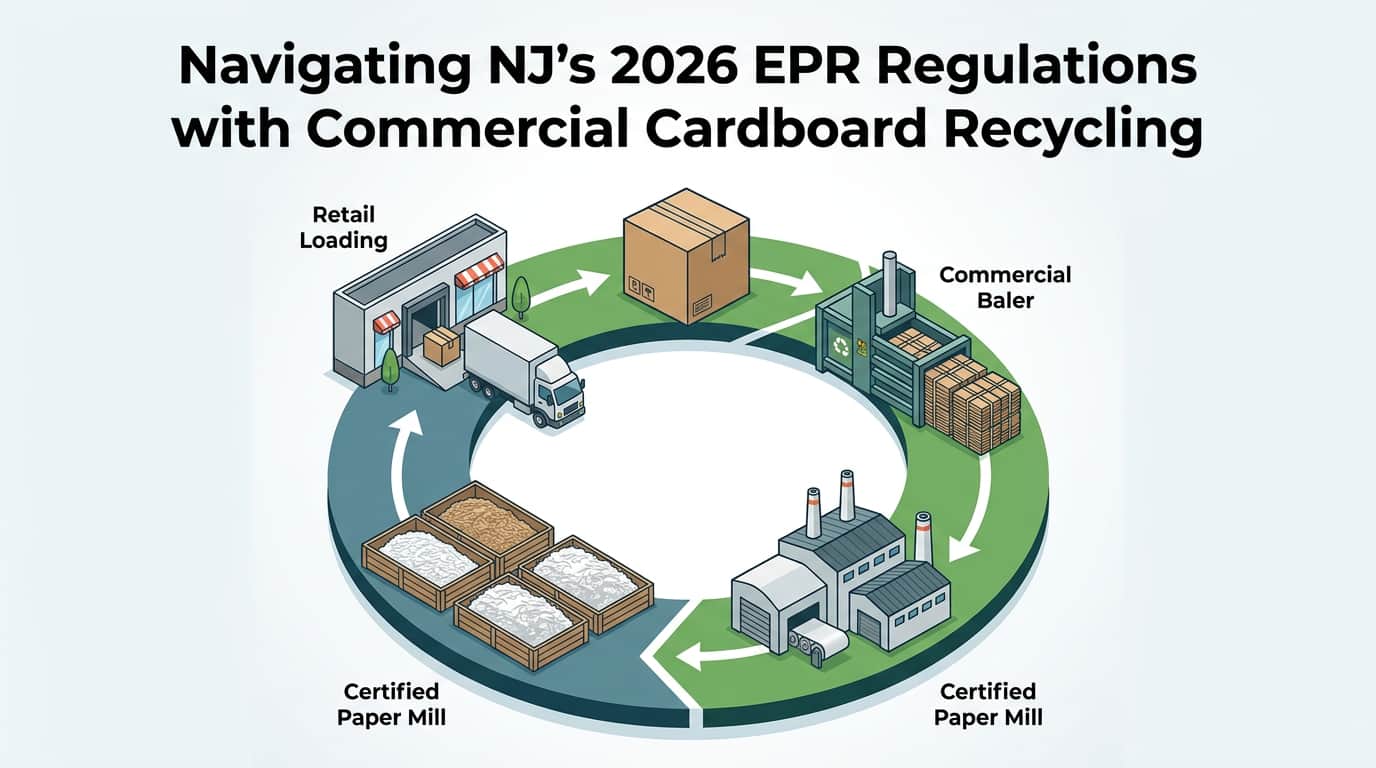
New Jersey businesses are about to face one of the most significant packaging compliance shifts in decades. The state's Extended Producer Responsibility (EPR) law takes effect in 2026, and if your operation generates cardboard waste, the clock is already ticking. Contact All County Recycling at (609) 393-6445 today to get ahead of the deadline before penalties start adding up.
This guide breaks down exactly what EPR means for your business, how to audit your current waste stream, and how the right recycling setup can turn a compliance burden into a genuine cost-saver.
New Jersey's EPR legislation places legal and financial responsibility for packaging waste on producers and the businesses that use that packaging. Starting in 2026, companies generating significant volumes of packaging materials, including corrugated cardboard, must meet diversion targets or face surcharges tied to the weight of materials sent to landfills. Businesses that fail to comply risk fees that can run into thousands of dollars annually, depending on the volume of unrecycled packaging they produce.
The law targets packaging across the supply chain, which means warehouses in the Trenton area, distribution centers near the Jersey Shore, and retail operations throughout Mercer and Burlington Counties all need to act now.
Cardboard is the single largest packaging material most businesses produce, and it's also the easiest to divert from the landfill. Getting your cardboard recycling program right is the fastest way to reduce your EPR liability.
Here's why it matters so much. Corrugated cardboard typically represents 30–40% of a commercial waste stream. Diverting that volume alone can dramatically reduce the surcharges your business owes under the new EPR framework. Beyond cost avoidance, baled cardboard actually generates revenue when sold back through certified recycling facilities, meaning the same material that once cost you money to haul away can start paying you back.
A waste stream audit tells you exactly which materials you're sending to the landfill and in what quantities. That information is the foundation of your EPR compliance strategy.
Follow these steps to get started:
Step 1: Identify all packaging inputs. Walk your receiving area and storage rooms. List every type of packaging that comes into your facility, paying close attention to corrugated boxes, chipboard, and cardboard sleeves.
Step 2: Estimate weekly cardboard volume. Count boxes or weigh loads over two weeks. Most mid-size businesses in New Jersey generate between 500 and 2,000 pounds of corrugated cardboard per week.
Step 3: Separate recyclables from trash. Track how much cardboard currently goes into your general waste dumpster. That's your EPR liability under the new rules.
Step 4: Calculate potential surcharge exposure. EPR fees are assessed per ton of non-diverted material. Even modest improvements in diversion rates, say moving from 40% to 85%, can cut your annual surcharge exposure by half or more.
Step 5: Document everything. The state will require proof of diversion. Keep pickup records, weight tickets, and certificates from your recycling partner.
Working with a certified recycling facility is the most direct way to reduce surcharges and stay out of trouble with state regulators.
Certified partners provide verifiable documentation of material diversion, which is the paper trail regulators will ask for. They also process materials through permitted facilities, which means your cardboard counts toward your diversion rate under the EPR framework. Businesses in Mercer County that have already partnered with certified recyclers report reducing their net waste disposal costs by 20–35% once cardboard is pulled from the general waste stream.
All County Recycling, based in Trenton, NJ, processes over 3,000 tons of material per month at its recycling center on Enterprise Avenue. That capacity means your materials get processed quickly, your documentation stays current, and your diversion numbers stay where they need to be to avoid EPR penalties.
Yes. A cardboard baler compresses loose boxes into dense, uniform bales that are far cheaper to store and transport than loose cardboard. More importantly, baled cardboard commands a better price on the commodity market than loose material.
Here's what the numbers typically look like for a mid-size New Jersey business:
Vertical balers work well for businesses producing under 10 bales per month. Horizontal balers suit higher-volume operations like distribution centers near the Somerset County logistics corridors. The right equipment choice depends on your weekly cardboard volume, which is another reason starting with an audit makes sense.
All County Recycling offers vertical and horizontal baling equipment as part of its commercial recycling programs, along with roll carts, containers, and trailers to match your facility's layout.
New Jersey's EPR law is the start of a longer regulatory trajectory, not a one-time requirement. The state has already signaled that diversion targets will increase incrementally through 2030, with packaging surcharges tied to performance benchmarks that get stricter every two years.
Businesses that build a documented recycling program now, complete with certified facilities, baling equipment, and weight records, will be positioned to meet tightening standards without scrambling to overhaul their waste programs under deadline pressure.
Three actions you can take this quarter:
Businesses from Trenton to Cherry Hill that started their cardboard recycling New Jersey programs 12–18 months before a regulatory deadline consistently reported lower compliance costs than those that waited until the final months. Don't wait for surcharge notices to start the process.
The 2026 compliance window is narrowing. The best time to build your commercial recycling program was last year. The second best time is now.
All County Recycling serves businesses across Mercer County, Somerset County, Burlington County, Middlesex County, Monmouth County, and Eastern Pennsylvania. Call (609) 393-6445 to schedule your free waste stream analysis and start cutting your EPR exposure before penalties take effect.